The Changing Landscape of Digital Marketing
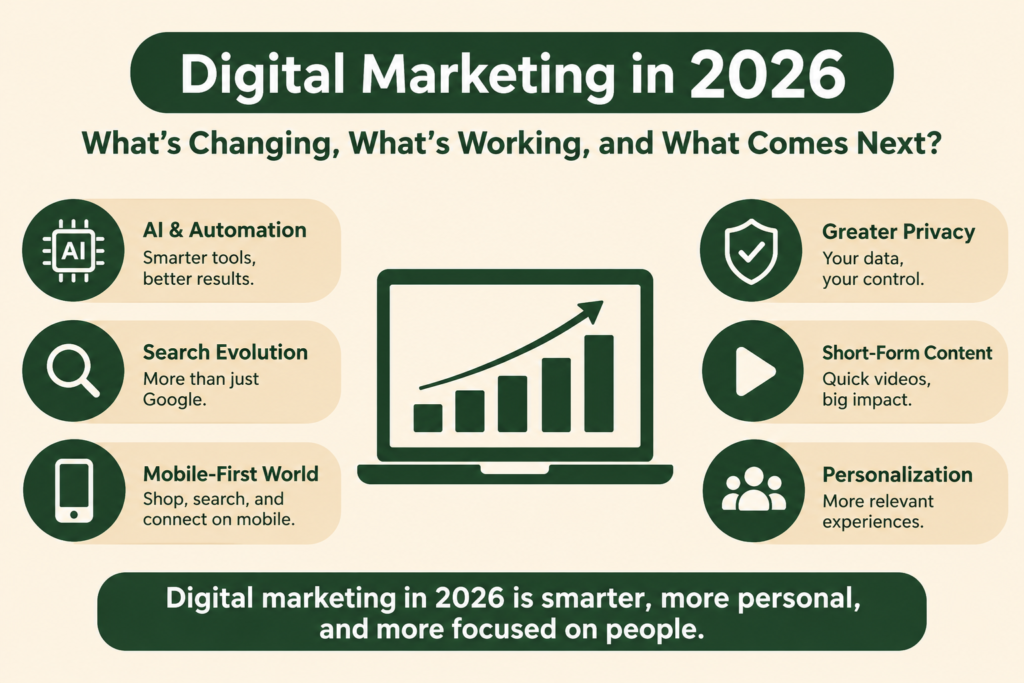
Digital marketing is evolving beyond traditional search engine optimisation, social media promotion, and online advertising. Changes in consumer behaviour, artificial intelligence, data privacy, and digital platforms are influencing how brands attract and retain customers.
People no longer depend on a single platform to discover information or make decisions. They may search on Google, watch product reviews on YouTube, explore recommendations on Instagram.
This creates a more complex customer journey for marketers. Brands must understand where their audiences spend time, what information they need, and how to provide a consistent experience across different platforms.
In 2026, successful digital marketing is increasingly about combining technology, creativity, data, and customer understanding rather than depending on one marketing channel.
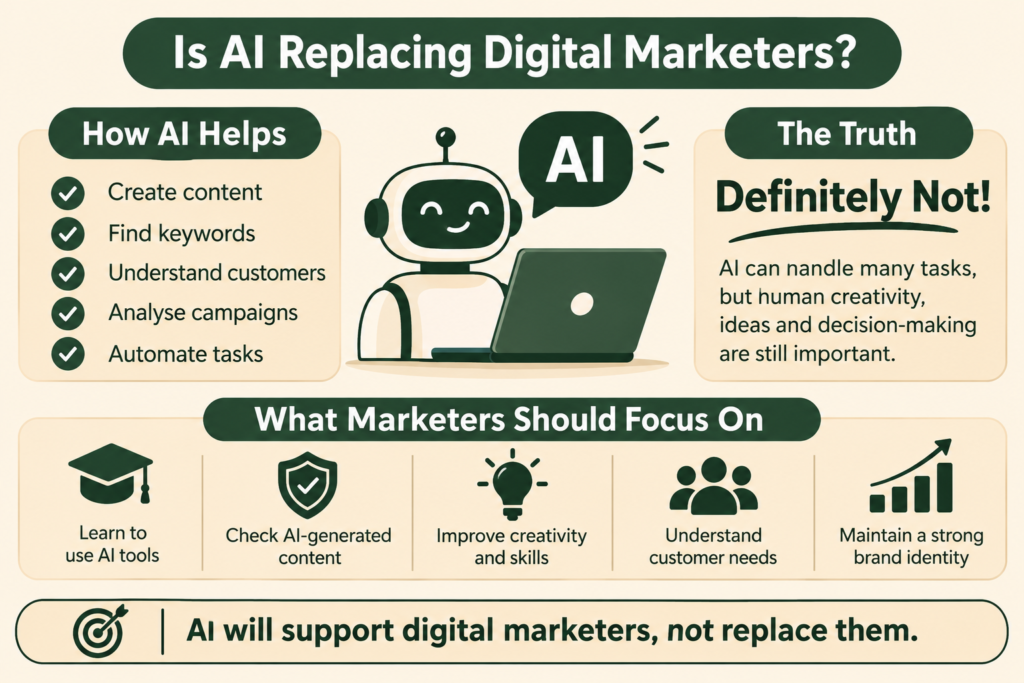
AI: Is AI Replacing Digital Marketers
AI is changing digital marketing. It helps marketers create content, find keywords, understand customers, analyse campaigns, and automate tasks.
But will AI replace digital marketers? Not completely.
AI can handle many tasks, but human creativity, ideas, and decision-making are still important. For example, AI can write social media captions, but marketers decide what best suits their brand and audience.
What marketers should focus on:
- Learn to use AI tools.
- Check AI-generated content.
- Improve creativity and marketing skills.
- Understand customer needs.
- Maintain a strong brand identity.
In short: AI will support digital marketers, not completely replace them.
SEO in 2026: Will Google Search Still Matter?
With the growth of AI-powered search experiences, many people are questioning whether traditional SEO is still worth investing in.
The answer is yes. Search engines continue to play an important role in online discovery, although the way people search and interact with results is changing.
Search queries are becoming more conversational and detailed. Instead of searching only for short keywords, users increasingly ask specific questions and expect useful answers.
Modern SEO therefore needs to focus on:
● Helpful, original, people-first content.
● Search intent rather than keyword repetition.
● Strong website structure and technical performance.
● Relevant internal and external links.
● First-hand experience and credible information.
● A good experience across mobile devices.
Social Media Marketing:Is Organic Reach Still Possible?
One common concern among businesses and content creators is the declining or inconsistent reach of organic social media posts.
Organic reach is still possible, but it is not guaranteed. Social platforms use recommendation systems that consider different signals, including content relevance, audience interests, interactions, and viewing behaviour.
Simply publishing frequently does not guarantee visibility..
A more effective approach is to create content that gives people a reason to watch, save, share, comment, or visit a profile..
Instead of chasing follower counts, marketers should focus on reaching the right audience and generating meaningful engagement.
Content Marketing: How Can Content Attract Customers?
Content Marketing: How Can Quality Content Attract More Customers?
Content marketing is an important part of digital marketing. It involves creating and sharing useful information to attract and engage customers. Businesses use blogs, social media posts, videos, images and website content to connect with their audience.
Good content helps customers understand products and services, builds trust and encourages them to choose a business.
Important elements of content marketing:
● Create useful content : Share information that answers customer questions.
● Understand your audience:Create content based on customer interests and needs.
● Use different formats: Publish blogs, videos, images and social media posts.
● Improve SEO:Use relevant keywords to help people find your content on search engine
● Build trust: Share clear, helpful and reliable information
● Track performance: Check website visits, engagement and enquiries to understand what works.
The main goal of content marketing is to provide value, build customer trust and turn visitors into potential customers.
Paid Advertising: Why Are Ad Costs Increasing?
Paid Advertising: Getting Better Results
Paid advertising on Google Ads and Meta Ads helps businesses reach more customers quickly. However, spending more money does not always guarantee sales or enquiries.
Results depend on targeting, ad quality, competition, and landing pages.
Marketers should focus on:
- Setting clear campaign goals.
- Targeting the right audience.
- Testing different ads.
- Improving landing pages.
- Tracking leads and conversions.
- Reviewing campaign performance.
The goal is not more clicks, but more customers at a reasonable cost.
Website Designing: What Makes a Website Attractive?
Website Designing: What Makes a Website Attractive and User-Friendly?
A good website should look attractive and be easy to use. Visitors should be able to find information quickly and move between pages without difficulty. A well-designed website creates a good first impression and keeps visitors interested.
Important features of a good website:
● Simple Design: Keep the layout clean and organised.
● Good Colours: Use colours that match the brand.
● Easy Navigation: Make menus and links easy to find.
● Mobile-Friendly: Make sure the website works well on mobile phones and computers.
● Fast Loading: Ensure pages open quickly.
● Good Images: Use clear and attractive pictures.
● Readable Text:Choose simple fonts and suitable text sizes.
● Clear Buttons: Use buttons like "Contact Us", "Shop Now" and "Explore More".
A good website should be attractive, easy to use and help visitors find what they need.
Marketing Analytics: Are Views and Likes Enough?
Marketing Analytics: Are Views and Likes Enough?
Getting thousands of views and likes does not always mean a business is successful. Marketers should also check whether their campaigns bring customers, enquiries and sales.
Important performance measures include:
Reach and Impressions: How many people see the content.
Engagement Rate: How people like, share and comment on content.
Click-Through Rate (CTR): How many people click on an ad or link.
Conversion Rate: How many visitors take action, such as making a purchase.
Cost Per Lead (CPL): How much money is spent to get one customer enquiry.
Return on Ad Spend (ROAS): How much money is earned from advertising.
Tools like Google Analytics and Google Search Console help businesses check their performance.
The main goal is not just to get more views and likes, but to attract customers and increase business results.
Digital Marketing Skills and Career Opportunities
The changing digital environment is also creating new opportunities for people interested in marketing careers.
Businesses increasingly need professionals who can combine marketing knowledge with technology, creativity, communication, and analytical skills..
Some important career areas include:.
● SEO Specialist.
● Performance Marketing Specialist.
● Social Media Manager.
● Content Strategist.
● Digital Marketing Analyst.
● Marketing Automation Specialist.
● Email Marketing Specialist.
● AI Marketing Specialist.
However, learning tools alone is not enough to build a successful career..
Employers and clients also value practical experience, problem-solving ability, campaign understanding, communication skills, and the ability to demonstrate results..
Common Digital Marketing Questions Answered
● Is digital marketing still worth learning in 2026?
Yes. Digital marketing continues to evolve, and businesses need professionals who understand online visibility, audience engagement, advertising, content, and analytics. Learning should be continuous because platforms and technologies change.
● Can a business grow without paid advertising?
Yes. Businesses can develop visibility through SEO, useful content, organic social media, referrals, and community engagement. However, organic growth can take time and does not guarantee immediate results.
● Does having more followers mean more sales?
Not necessarily. A smaller audience with genuine interest in a product or service may generate more valuable enquiries and sales than a large but unrelated audience.
● Is SEO dead because of AI?
No. SEO is changing rather than disappearing. Search engines and AI-powered discovery experiences create new ways for people to find information. High-quality content, technical website p
What Will the Future of Digital Marketing Look Like?
The future of digital marketing will be shaped by the relationship between artificial intelligence, changing search behaviour, data, creativity, and customer expectations.?
AI-powered tools are likely to become more integrated into everyday marketing activities, while search experiences will continue expanding beyond traditional keyword-based discovery.?
At the same time, authentic communication and customer trust will remain important. As AI-generated content becomes easier to produce, original insights, real expertise, and distinctive brand experiences can help businesses stand out.?
Marketers will also need stronger measurement skills to understand the real contribution of different channels and campaigns.?
The most successful professionals and businesses will not necessarily be those using the largest number of tools. They will be those who understand their audiences, adapt to change, use technology responsibly, and focus on measurable outcomes.
Digital marketing in 2026 is not simply about keeping up with new platforms or adopting every emerging technology. It is about understanding how people discover information, evaluate brands, and make decisions in an increasingly connected world.
AI, SEO, social media, advertising, analytics, and customer data are all important parts of this changing environment. However, none of these tools can replace the need for a clear strategy and genuine audience understanding.
The future belongs to marketers who can combine technology with creativity, data with human judgement, and online visibility with meaningful customer experiences.
Digital marketing is changing. The opportunity is to learn, adapt, and create value through that change.